
XR Case Study
Point It at the Poster. Navigate Through Time.
QuantumERA partnered with UTRGV's CHAPS program to transform a classroom archaeological poster a fully immersive mobile AR experience that brings 10,000 years of South Texas Native American history off the page and into students' hands.
Project Summary
| Client | University of Texas Rio Grande Valley (UTRGV) |
|---|---|
| Program | CHAPS (Cultural Heritage & Archaeology Program for Students) |
| Location | Edinburg, Texas |
| Platform | iOS · Android |
| Technology | Immersive Augmented Reality · 3D Modeling · 360° Animation · Unity |
| Project Date | 2018 |
| Audience | K-12 Students |
The Challenge
The Lower Rio Grande Valley stretches along the US-Mexico border as a largely arid landscape of sand and brush. Beneath its surface and scattered across its plains lies evidence of continuous human habitation stretching back more than 10,000 years. UTRGV’s CHAPS program, spanning anthropology, archaeology, history, and earth sciences, has spent years documenting that presence, tracing how post-Pleistocene environmental change shaped the migration, settlement, and material culture of the Native peoples who called this region home.
The primary surviving evidence of that presence is projectile points — arrowheads crafted from stone, shell, bone, glass, and metal across seven distinct archaeological periods, from the Paleo Indian era of 9,200 B.C.E. to the Historic Period of the 1600s. UTRGV had assembled this record into an educational poster for K–17 classrooms across the Rio Grande Valley, cataloguing dozens of named point types and mapping them to their precise periods in time. It was a remarkable document, but a flat one. What UTRGV needed was a way to make those arrowheads three-dimensional, interactive, and alive.
The Solution
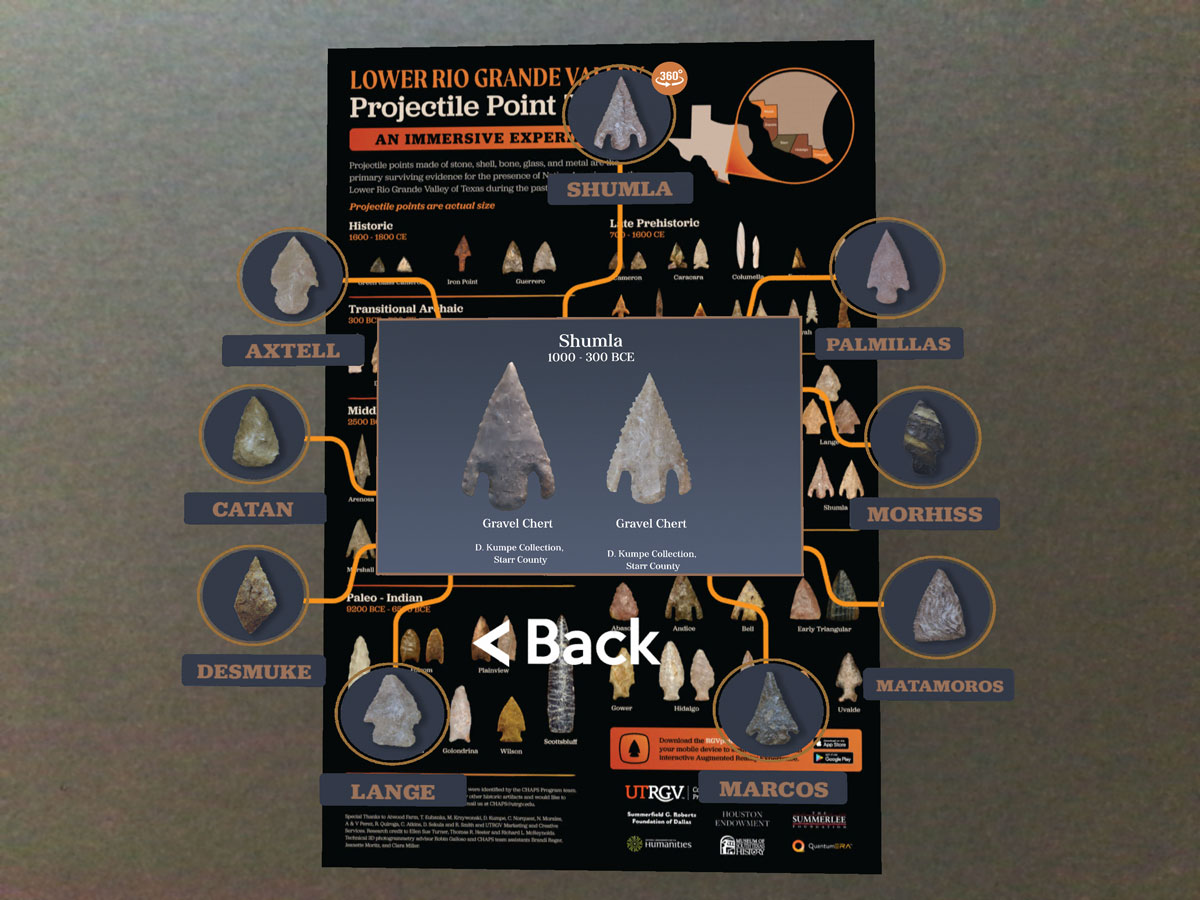
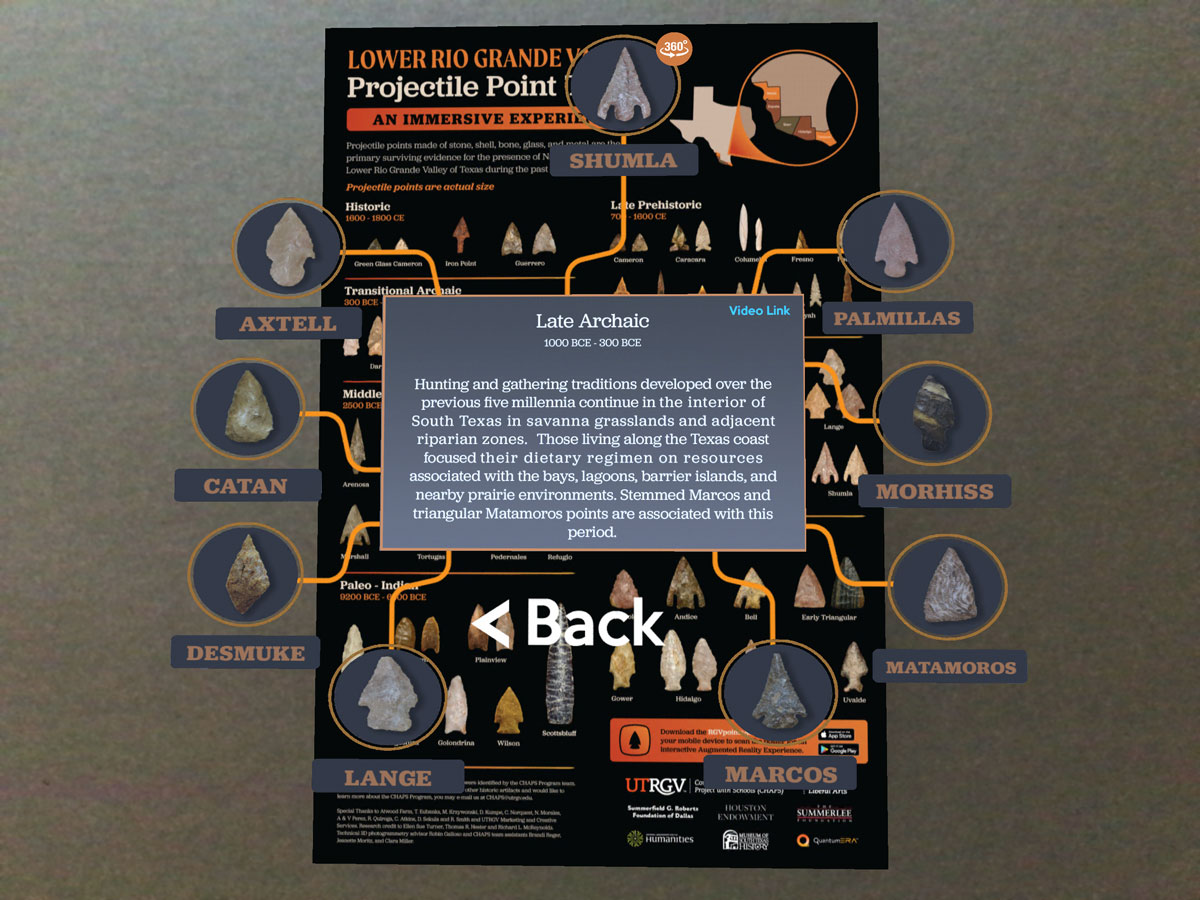
QuantumERA served as creative director and technology lead, partnering with Austin-based studio MoontowerVFX to build UTRGV’s mobile AR app for iOS and Android that uses the classroom poster itself as the AR target. No QR code, no separate marker: students simply download the app, point their camera at the poster, and begin navigating through time.
The project unfolded in two phases:
Phase 1: Prototype (2019)
The first phase established proof of concept and technical pipeline. Using the poster as the camera target, the app activated around a single arrowhead period. One point was rendered as a fully interactive 3D model that students could lift off the poster, rotate with a finger, and physically walk around in augmented space. A second arrowhead within the same period surfaced educational text callouts on-screen; a third triggered linked video and audio content provided by UTRGV. Built in Unity and distributed via TestFlight for validation, the prototype confirmed that the poster-as-portal concept was both technically viable and pedagogically compelling.
Phase 2: Full Production (2021)
With the prototype validated, QuantumERA returned to complete the full experience. The remaining 21 arrowhead points spanned all seven archaeological periods and were animated with 360° interactive AR, each tagged to its historical period and classification. QuantumERA updated the app’s UI/UX for consistency across the full expanded experience, coordinated with UTRGV’s IT team to configure server-hosted video links, tested the new build in a staged environment with UTRGV sign-off, and submitted the completed app to both the Apple App Store and Google Play.

Key Features
Poster-as-Portal
The classroom poster is the AR trigger; point your camera at it and the experience begins
360° Interactive 3D Models
Students lift arrowheads off the page, rotate, zoom, and walk around them in augmented space
Multi-Media Content Layers
Each point links to text callouts, photography, and video/audio content provided by UTRGV
Cross-Platform Delivery
Published to both Apple App Store and Google Play; students use their own devices
Classroom-to-Field Continuity
Designed equally for the K–12 classroom, university scholars, and Geo-Heritage tourists exploring the US-Mexico border region
Scalable Asset Architecture
Modular content system built for UTRGV to expand as the collection and research grows


The Impact
“The QuantumERA team came very highly recommended to us by the Witte Museum in San Antonio. They were able to successfully bring our project to fruition. This product has been extremely well received amongst K–12 educators and their students, with geology professionals and hobbyist collectors alike.”
— Roseann Bacha-Garza, M.A., CHAPS Program Manager, UTRGV
RGVpointsAR is live in both the Apple App Store and Google Play. It is embraced not only by K–12 classrooms across the Rio Grande Valley but by geology professionals and hobbyist collectors drawn to the region’s Geo-Heritage story. The relationship between QuantumERA and UTRGV has extended well beyond launch into an ongoing maintenance partnership — a testament to the reliability and long-term trust the team has built with the institution.